Translating the Coverstones
Unlocking The Stargate
In the original Stargate movie, Daniel Jackson deciphers the inscriptions on the coverstones which were placed above the Stargate when it was buried. There are three sections of the coverstones: the inner circle, and two outer "tracks". The main feature of the inner circle is a cartouche containing mysterious symbols, the inner track contains hieroglyphics, and the outer track contains more mysterious symbols.
Daniel declares that the mysterious symbols "aren't hieroglyphics, they might be a form of hieratic or cuneiform".
Hieratic was the script form of hieroglyphics, that was used for quicker writing on papyrus, and thus was much more stylized and simplified. Cuneiform was the writing system used by the Assyrians and Babylonians of Mesopotamia, done by pressing a pointed stylus into wet clay, thus producing a very recognisable style of wedge-shaped lines. Though the mysterious symbols are very pointy, they don't really look like cuneiform. This simply shows that Daniel is much more familiar with hieroglyphics than with cuneiform, which is reasonable, since he is an Egyptologist, after all, not a specialist in Mesopotamia. He knows enough about the general area to consider cuneiform as a possibility, while not knowing enough to rule it out immediately, as he did with the possibility that the symbols were hieroglyphics.
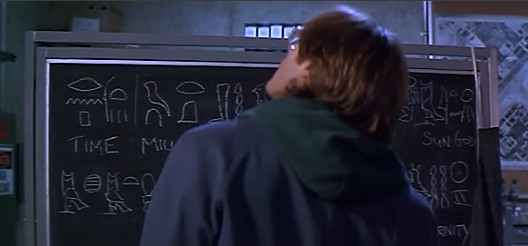
He then looks at the blackboard which is set up next to the coverstone and says that the translation of the hieroglyphs is wrong, that whoever did it "must have used Budge - I don't know why they keep reprinting his books". Budge probably refers to E.A. Wallis Budge, whose books on Egyptian are still easily obtainable (you can even get them from <http://www.amazon.com>!) but are "hopelessly out of date... a generation of readers confused by his use of vowels". (Thanks to <http://www.friesian.com/egypt.htm>)
The blackboard with the hieroglyphics has three lines of inscriptions written on it, with the English underneath. The hieroglyphs in the third line are only visible for a fraction of a second, and we only see a portion of the English in that line.
Daniel then corrects certain errors that he sees - replaces "coffin" with "buried", something (possibly "time") with "years", something else with "for all time", and "door to heaven" with "his stargate".
The translation which Daniel provides is
line 1: million years into the sky is Ra Sun God
line 2: sealed and buried for all time
line 3: his Stargate
I expect that there is actually more on line 3 than just "Door to Heaven", but since that was the only part of it that Daniel remarked upon, replacing "Door to Heaven" with "Stargate", we don't know what the translation of the rest of that line is.
However, thanks to the painstaking perseverance of emk here is a representation of the hieroglyphs that were on the blackboard, including the third line.

The hash marks are partially obscured signs, or ones which were guessed based on shape and context.
A partial translation by emk of the third line is:
door (or gate) / to / stars / his
"his door to the stars"
Which certainly fits with Daniel calling it "his Stargate".
Daniel also remarks about the "interesting use of an adverbial", and a word, which I originally thought was "keveh", but is more probably "quebeh", since the hieroglyphs which he was pointing to were left-pointy sand-dune (Q), foot (B) and twisted wick (dotted H). This is also interesting because it shows that the hieroglyphs on the blackboard are written from left to right. I used to think that Egyptian writings were always written from right to left, but apparently the direction is arbitrary, it is determined by the direction which the figures are facing. (Thanks to Aoibhe O'Sullivan for pointing this out).
The other thing to remember is that ancient Egyptian hieroglyphics had no symbols for vowels; it was, like ancient Hebrew writing, all consonants. That isn't to say that there were no vowels in the spoken language - simply that, in the written language, you were supposed to get enough from the context to be able to know what word it was without having to specifically write down the vowel sounds.